
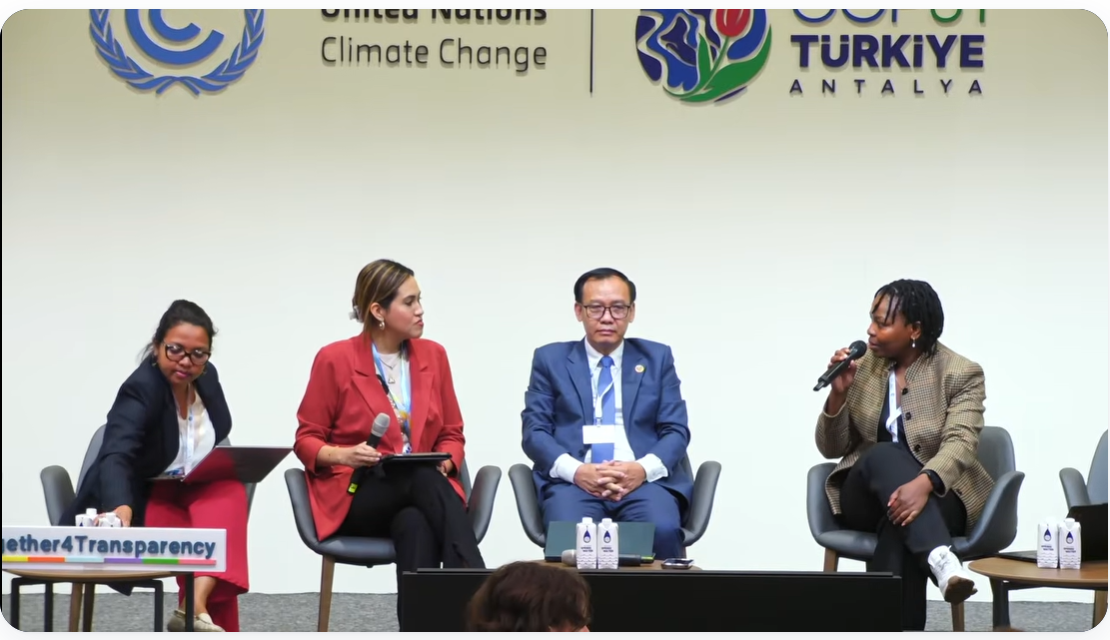
As leaders gather in Antalya for the second day of the COP31 summit, a quieter but foundational conversation is taking place on the margins: how better transparency systems are helping countries turn their climate pledges into concrete action.
“2026 has been a year with a lot of progress on transparency,” said Dr Henning Wuester, director of the Initiative for Climate Action Transparency (ICAT). “Transparency allows the Paris Agreement to get going on the ground. It moves the agreement from a piece of paper to action on the ground.”
Speaking at a session on how transparency is advancing the implementation of Nationally Determined Contributions (NDCs), Wuester argued that robust data and monitoring systems are shifting the way countries design and deliver their climate plans. Instead of setting vague targets disconnected from reality, governments are increasingly using analytical evidence to ground their commitments. There is also growing interest in assessing the actual impact of policies and measures as the basis for realistic implementation plans.
One practical advance has been the application of ICAT’s climate finance transparency methodology. According to ICAT’s 2025 Impact Report, six countries worked on building climate finance transparency frameworks last year. Earlier applications and ongoing projects bring the number of countries that have applied or are applying the methodology closer to the ten cited by Wuester at the session. These include Belize, Côte d’Ivoire, Senegal and Niger, with additional Francophone African countries such as Cameroon and Comoros at earlier stages of planning and peer learning. Five Francophone African countries that applied the methodology confirmed that the process had strengthened collaboration between ministries, particularly between environment and finance authorities.
While the tools do not automatically unlock funding, Wuester noted they “set the foundation in mobilisation of finance” by creating a clearer picture of needs, gaps and flows. Yet the relatively small number of countries that have so far adopted the approach underlines that far more need to join if transparency is to become a widespread enabler of NDC implementation. ICAT continues to expand support including a recent call for a national implementing partner in Morocco — reflecting both demand and the remaining gap.
Country experiences presented at the session illustrated how these shifts look in practice.
In Madagascar, Ambinintsoa Heritokilalaina, known as Lalainà, head of the databases and monitoring and evaluation department at the National Office for Climate Change and REDD+ and a climate negotiator for the country, described a significant institutional change. “One of our most significant achievements has been our gradual transition from fragmented data collection on the reporting process to a more coordinated and structured national framework,” she said. Madagascar has also established a network of sectoral focal points across ministries and institutions and strengthened their capacity on data collection.
Andrea Lucrecia Fión Góngora, Guatemala’s national focal point for the UNFCCC at the Ministry of Environment and Natural Resources, emphasised that indicators must reflect the realities of the sectors responsible for delivery. “Our indicators must be built taking into consideration sectorial needs,” she said. In the energy sector, for example, Guatemala’s NDC includes measures to increase renewable generation. Monitoring those measures requires data on energy capacity that only the sector itself can provide. “We work very closely with them to make sure that implementation would be done by the sector itself.”
The discussion comes at a moment when the credibility of climate commitments is under intense scrutiny. COP31, hosted by Türkiye with Australia chairing the negotiations, is focused on accelerating implementation rather than new grand declarations. Transparent systems for tracking progress, assessing policy impacts and clarifying finance needs are increasingly seen as essential infrastructure for that shift.
Wuester’s message was measured. Better transparency does not solve every barrier, particularly around the scale and accessibility of climate finance. But it is creating the conditions for more informed strategies, stronger inter-ministerial coordination and targets that stand a better chance of being delivered. With only a limited group of countries so far applying the finance methodology in depth, scaling these approaches remains one of the quieter but more practical challenges facing the Paris Agreement’s next phase of implementation.
Article by Gideon Sarpong